About
Founded as a documents repository in 1979, today it is among the largest indigenous peoples libraries in the world.
History
In 1979, at the historic Conference of Tribal Governments held at the Tyee Hotel in Tumwater, Washington, Rudolph “Rudy” Rÿser—speechwriter and senior policy advisor to Joe DeLaCruz, President of the Quinault Indian Nation—was asked to develop a research and documentation center. This center would serve as a global library and resource for tribal communities, creating a central source where tribes in the Pacific Northwest, as well as around the world, could send and access information.
Thus began the Center for World Indigenous Studies (CWIS), which over the years expanded its mission to serve as a global Indigenous Peoples resource for research, education, and legal and policy advancement. Chief George Manuel of the Secwépemc Nation joined Rudy—who later became Dr. Rÿser and author of the seminal book on Indigenous self-determination, Indigenous Nations and Modern States—in founding CWIS.
During the 1980s through the present, CWIS has grown into a research, education, and policy think tank—continuing to build its repository while also generating new knowledge through advisory services, technical support, and work in Fourth World geopolitics and traditional medicine.
As the decades have passed, Indigenous centers and libraries have emerged around the world, and academic programs in Indigenous Studies have taken root. CWIS has been part of this broader movement, including through the publication of The Fourth World Journal, first issued in 1984 and published continuously since—initially in print and now digitally, becoming open access in 2025 with support from the Robert Wood Johnson Foundation. The journal archive is hosted on our sister site.
The Early Days of the Library
In its early years, the library took shape through the steady movement of materials across distances—documents mailed in hard copy, faxed from around the world, or carried by hand during the many years Rudy attended United Nations meetings in New York and Geneva, where discussions that would eventually lead to the adoption of UNDRIP were unfolding. Over time, this growing collection came to include not only written records but also audio recordings, photographs, and early video materials documenting Indigenous voices and experiences.
Working alongside interns, Rudy’s young sons helped enter document records into early computer systems such as Commodore and Compaq machines. Later, John Burrows, a recent graduate of The Evergreen State College, joined the team and developed the CWIS Fourth World Documentation Project on a Bulletin Board System.
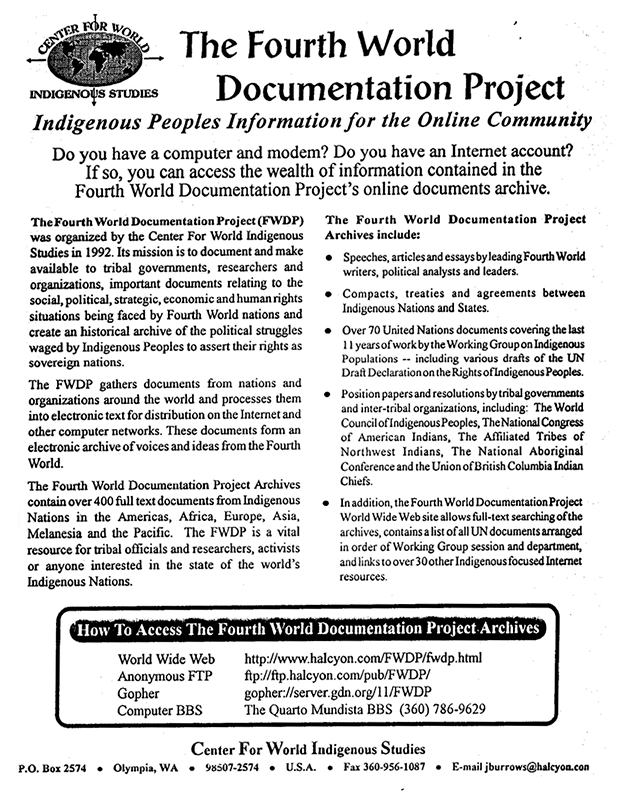
Photo: Scan of an early Fourth World Journal flyer.
The World Wide Web
When the internet expanded into the World Wide Web in 1991, CWIS was ready, becoming one of the first Indigenous libraries online and soon recognized as a pioneering node in the emerging web of global knowledge.
The library was built and organized by volunteers and interns, as there has been, both then and now, very limited funding to support Indigenous-directed organizations.
A Living Archive
In 2021, CWIS staff began a comprehensive review of its holdings—documents, resolutions, white papers, records, images, audio, and video—shared by Indigenous nations around the world. Together, these materials represent generations of knowledge, advocacy, and lived experience, originally organized across more than 300 boxes of hard-copy files alongside many terabytes of digital data.
Following generous annual gifts from Laurel Gonsalves, a former CWIS board member and ongoing supporter of the CWIS and CTM mission, a plan was launched to create a globally accessible, open-source library ready for the 21st century and beyond. Since 2022, a dedicated team has been working to develop innovative ways to make this content accessible, ensuring that what was once dispersed, fragile, or difficult to reach can now be shared more widely, supported by thoughtfully created metadata that helps surface and contextualize each record.
What you now have access to marks the beginning of that effort: a growing collection shaped by Indigenous communities and peoples worldwide. Within these holdings are not only documentation, resolutions, and policies, but also photographs, recorded voices, and moving images, alongside records of land incursions, displacement, and genocide—testimonies of survival, resistance, and continuity.
As this library continues to grow, it remains grounded in its original purpose: to serve as a living resource where Indigenous knowledge—in all its forms—is preserved, shared, understood within its context, and carried forward for future generations.
Learn more about the Center for World Indigenous Studies.